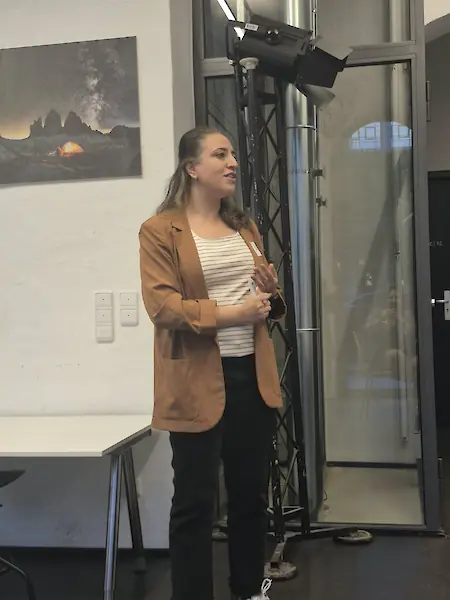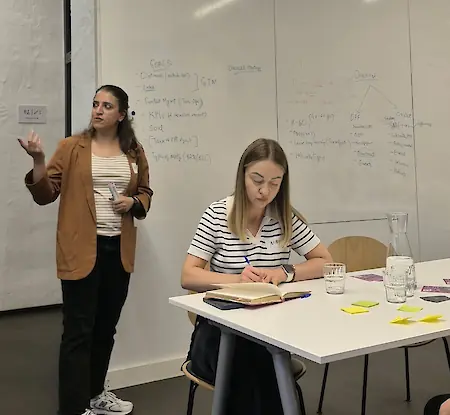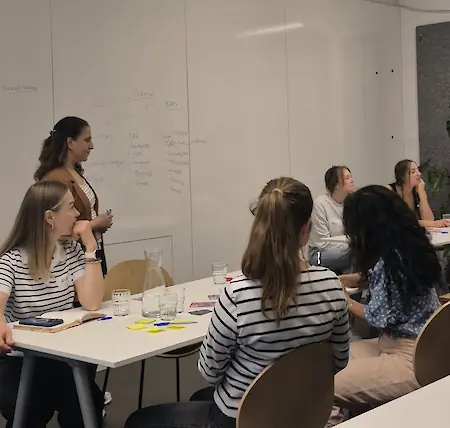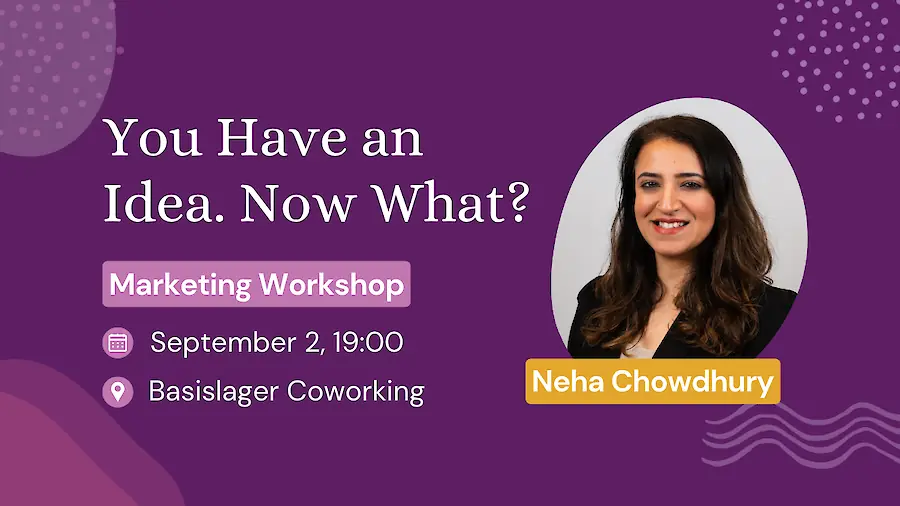
Speaker: Neha Chowdhury
Know more about NC Agentur on the website
Connect with Neha on LinkedIn
Marketing can feel overwhelming, especially when you’re running a small business, working as a solopreneur, or developing your first product or service. There are countless platforms, tools, strategies, and trends to keep up with… Effective marketing starts with much simpler questions.
1. WHO — Know Your User Persona
Before deciding what to post, where to advertise, or which platform to use, start by understanding who you are trying to reach.
A user persona describes the person you want to communicate with and can include several dimensions:
-
Demographics: age, gender, marital status, location, language, etc.
-
Behaviour: How do they behave online and offline? What platforms do they use? How do they make decisions?
-
Interests: What topics, activities, products, or communities are relevant to them?
-
Context: Where are they in their life or situation when they encounter your product or service?
Understanding behaviour is particularly useful when deciding on your marketing channels. You don't choose the channel first and then look for an audience — your audience should help determine where you show up.
2. PROBLEM — What Are You Actually Solving?
Instead of starting with “What am I selling?”, start with: “What problem am I solving?”
People don't necessarily buy a product or service because of the product itself. They buy because of the value or solution it provides.
Ask yourself:
-
What problem does my product/service solve?
-
What does my customer need?
-
What value am I offering?
-
Why should someone choose me over another option?
-
What makes my solution different?
-
What do I want people to associate with my brand?
Your value proposition should make this clear.
It can also connect strongly to your storytelling: How do you communicate the problem, your solution, and why you are the person/business to provide it?
Market the problem you solve, not just the product you sell.
3. CHANNEL — Where Can You Reach Them?
Once you understand your audience, you can start thinking about where they are and which channels make sense for reaching them.
Offline channels
-
You as the founder/CEO
-
Networking events
-
Conferences
-
Events and workshops
-
Billboards
-
Direct mail
-
Newspapers
-
Radio
-
Other physical or community-based opportunities
Online channels
-
Social media platforms
-
Influencer collaborations
-
Website
-
App
-
Online advertising / performance marketing
-
Webinars
-
Email marketing
-
Newsletters
You don't need to be everywhere.
Especially for small businesses and solopreneurs, starting with one, or at most two, channels can be much more effective than trying to maintain a presence on every platform.
Every platform has its own audience, content formats, and algorithms. Choose the channels where your user persona is actually present and where you can realistically create valuable content.
A combination of channels can also work well, for example, using your website as a central information point while using one social platform to reach your audience.
4. PROMPT — What Do You Want Them to Do Next?
What do you want your audience to do? This is your prompt / call to action (CTA).
The desired action doesn't always have to be:
-
Buy
-
Sign up
-
Register
-
Book
Depending on your business and where someone is in their customer journey, the desired action could also be:
-
Remember your brand
-
Share your content
-
Tell a friend
-
Visit your website
-
Follow you
-
Come back later
-
Ask a question
-
Attend an event
-
Save your content
The important thing is to be clear about what needs to happen next.
And that next step should make sense for the stage your audience is currently in.
The Customer Journey
The four questions above are closely connected to another important concept: the customer journey.
Not everyone who encounters your business is ready to buy immediately. People can be at very different stages when they interact with your marketing.
Awareness
At the awareness stage, someone may not even realize they have a problem yet.
They might need:
-
Basic information
-
Definitions
-
Education
-
Problem awareness
-
Content that helps them recognise a need
Question to ask:
What does my audience need to know before they even start looking for a solution?
Interest
Now they are becoming aware of the problem, or perhaps they have become aware of your brand, but they don't know the specifics yet.
They may want:
-
More information
-
Explanations
-
Examples
-
Educational content
-
Comparisons
-
Answers to common questions
Question to ask:
What would someone want to know once they realise this problem is relevant to them?
Desire
At this stage, people are actively considering possible solutions.
They might be asking:
-
Is this the right solution for me?
-
Can I trust this business?
-
How is this different from other options?
-
Does it actually work?
-
What have other people experienced?
This is where proof, testimonials, examples, case studies, FAQs, and differentiation can become particularly useful.
Question to ask:
What would convince someone that my solution is worth choosing?
Action
Depending on your business, this could mean:
-
Making a purchase
-
Booking a service
-
Signing up
-
Registering for an event
-
Contacting you
-
Requesting more information
Your prompt should make this next step clear and easy.
Question to ask:
What is the next action I want this person to take?
Content matches the Customer Journey
One important implication of the funnel is that not all content should try to sell.
Your audience will have different questions at different stages.
Awareness → What do they need to learn?
Interest → What do they want to understand?
Desire → What do they need to believe or compare?
Action → What do they need to do?
This means your content strategy should include different types of content that speak to different stages of the customer journey.
General Marketing Tips
-
Start simple
Marketing doesn't have to begin with:
-
Complicated tools
-
Huge budgets
-
AI agents
-
Being active on every platform
-
Becoming a full-time content creator
Start by understanding your user, problem, channel, and prompt.
-
Let your audience guide your decisions
Your user persona should influence:
The better you understand your audience, the easier it becomes to decide what to communicate, where to communicate it, and what action to encourage.
-
Be the product you would want
Create a product you would genuinely want to buy, or a service you would genuinely hire yourself for.
Your own standards and experience can be a useful starting point for understanding the value you want to provide.
-
Marketing isn't always perfectly predictable
Not everything can be reduced to a formula. Sometimes marketing also involves intuition and experimentation.
Test things. Pay attention to what resonates. Learn from your audience. Adjust.
And remember: you are the soul of your marketing.
-
Build trust
Especially for small businesses, trust can be one of your strongest marketing assets.
Consider using:
-
Testimonials
-
Customer stories
-
FAQs
-
Demonstrations
-
Examples of your work
-
Behind-the-scenes content
-
Expertise and educational content
-
Social proof
Key Takeaways
-
Start with the person, not the platform. Understand your user persona before choosing your channels.
-
Market the problem you solve, not just the product you sell.
-
Think about your marketing through four questions: Who? Problem? Channel? Prompt?
-
You don't need to be everywhere. Start with one or two channels that make sense for your audience and your capacity.
-
Your audience's needs change throughout the Awareness → Interest → Desire → Action journey.
-
Create content that answers the questions people have at each stage.
-
Your CTA doesn't always have to be a purchase. Think about the next appropriate action.
-
Marketing is about being noticed, trusted, and ultimately contacted.
-
Don't underestimate intuition, experimentation, and the human side of marketing.