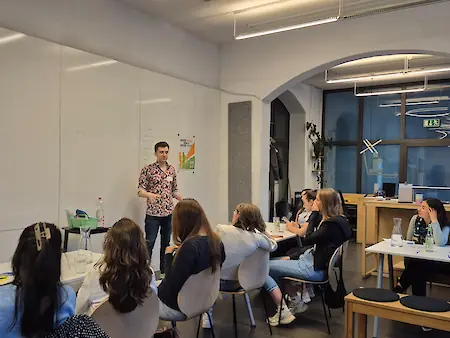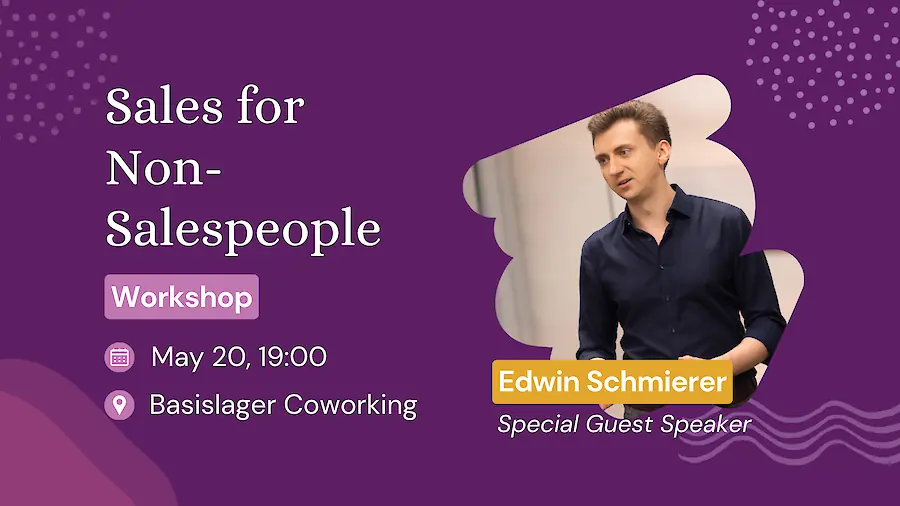
Speaker: Edwin Schmierer | Connect with Yen LinkedIn
🎤About the speaker
Edwin Schmierer focuses on helping freelancers, entrepreneurs, and creatives approach sales in a more structured and intentional way. His workshops combine practical sales strategies with communication and positioning techniques that feel accessible even for people who do not identify with traditional sales culture.
Introduction
One of the key ideas explored during this workshop was that sales is not limited to “salespeople.”
If you are offering a service, product, idea, collaboration, or project, you are already selling. The session focused on practical strategies to structure the sales process in a more confident and intentional way, especially for freelancers, entrepreneurs, and creatives.
The workshop covered four main topics:
- Pitching
- Qualification
- Negotiation
- Pricing
1. Pitching
A pitch is not about explaining every detail of your business. Its purpose is to:
- Create curiosity
- Resonate with the right audience
- Encourage further conversation
A strong pitch acts as a signal for your target audience:
“This might be relevant for me.”
Basic Pitch Structure
1. Niche / ICP (Ideal Customer Profile)
Define who you are speaking to and who your target audience is.
Examples:
- Female founders
- Startups
- Small businesses
- Creatives
- NGOs
- Tech companies
2. The Problem
Identify the problem your audience is experiencing.
Focus on:
- Pain points
- Frustrations
- Inefficiencies
- Missed opportunities
An important reflection during the workshop:
What are people missing out on if they do not solve this problem?
3. The Solution
Explain the transformation or result you help create rather than only focusing on technical details.
Your pitch should communicate:
- What you help people achieve
- What result you provide
- What value your service creates
Pitching Tips
Use the language of your clients
If you already work with clients:
- Ask for feedback
- Ask how they describe your service
- Ask what value they received
Using their wording can make your communication:
- Clearer
- More relatable
- Better aligned with customer needs
Focus on the problem that creates the most value
If your service solves multiple problems, prioritize the one that:
- Creates the most value
- Generates the most revenue
- Resonates strongest with your audience
Differentiate yourself
Ask yourself: Why should someone choose you over competitors?
Your differentiation could be:
- Your approach
- Your expertise
- Your niche
- The experience you create
2. Qualification
Qualification helps determine:
- Whether the client is a good fit
- Whether the project is aligned
- Whether there is real collaboration potential
One key insight:
Sales conversations should focus more on listening than talking.
For every one minute you speak, the client should ideally speak for around two minutes.
Open vs. Closed Questions
Open Questions
Examples:
- Why?
- What?
- How?
Purpose:
- Gather information
- Understand motivations
- Identify needs
- Explore problems
Closed Questions
Yes or no questions are useful to:
- Clarify decisions
- Confirm details
- Move conversations forward
The BANT Framework
A framework introduced during the workshop:
- B – Budget
How much are they willing or able to invest? - A – Authority
Is this the person who can make the decision? - N – Need
What problem are they trying to solve? - T – Time
When do they need the solution?
The GOAT Framework
Another framework shared during the session:
- G – Goals
What are they trying to achieve? - O – Obstacles
What is preventing them from reaching those goals? - A – Actions
What actions are they currently taking? - T – Time
What is their timeline?
3. Negotiation
One of the key negotiation insights was understanding who is sitting across from you.
Understanding the client helps you:
- Adapt your offer
- Understand priorities
- Negotiate more effectively
Scope & Budget Alignment
A project should match:
- The available budget
- The complexity of the work
- The resources required
If the scope increases, more:
- Time
- Expertise
- Resources
will also be required.
Upselling
Upselling is often easier with people who already:
- Know your work
- Trust you
- Engage with your content or services
Examples:
- Existing clients
- Newsletter subscribers
- Community members
- Followers
Warm audiences are often easier to convert than cold leads.
Subcontracting
Subcontracting can help when:
- A project is too large
- The work falls outside your expertise
- The opportunity is difficult to handle alone
Instead of rejecting a project completely, parts of the work can be delegated to trusted collaborators.
This can help:
- Maintain quality
- Optimize time
- Scale services more sustainably
4. Pricing
Understanding the cost of being self employed is an important part of sustainable pricing.
A simplified formula shared during the workshop:
Annual Living Expenses / 1000 billable hours = Base Hourly Rate
The idea behind this approach:
- Estimate annual personal and business costs
- Divide them by approximately 1000 billable working hours per year
- Use the result as a pricing baseline
Consider availability & capacity
The formula assumes that all billable hours are booked consistently. If work is irregular or availability is uncertain, prices may need to increase to compensate for downtime and non billable work.
One recommendation shared during the workshop:
Multiply the baseline by two as a safety margin when necessary.
Offer different pricing levels
Participants also discussed creating different levels of services or products, such as:
- Premium or high touch offers
- Lower cost entry offers
- Smaller starter packages
- Scalable services
This creates flexibility for different audiences and budgets.
Key Takeaways
- Sales is a skill that can be learned and structured
- A good pitch creates curiosity, not overload
- Clear communication starts with understanding the audience
- Listening is more important than dominating the conversation
- Qualification helps identify the right opportunities
- Negotiation is about understanding needs and priorities
- Pricing should reflect both value and sustainability
- Client language and feedback are valuable positioning tools