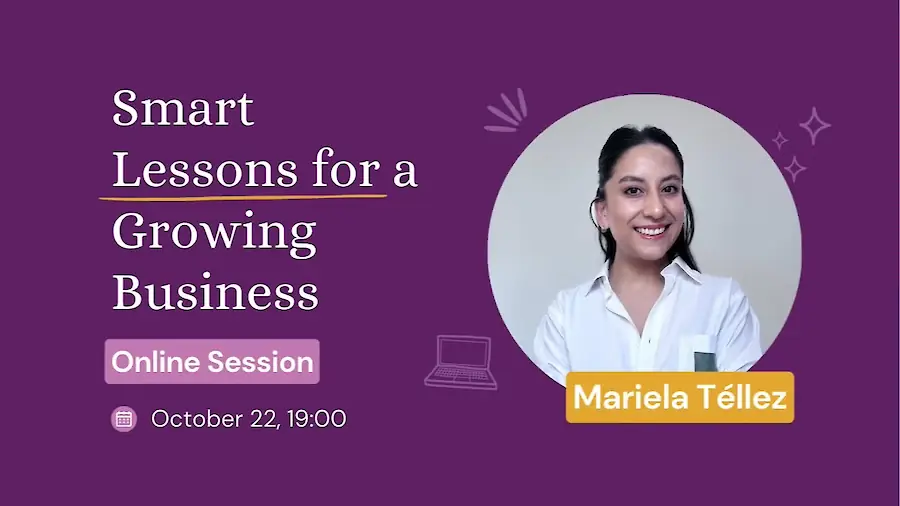
Speaker: Mariela Téllez | Connect with Marina on LinkedIn
In this inspiring session, we explored how growing your business starts with growing your mindset. 💜
Drawing from Carol Dweck’s concept of the Growth Mindset, we learned that success doesn’t depend on talent or resources alone — but on our willingness to learn, adapt, and evolve. A growth mindset helps us see challenges as opportunities, not obstacles, and keeps our businesses moving forward even in uncertain times.
Our speaker shared a powerful metaphor:
👉 A business is like a ship.
You need a compass, a crew, and a plan for storms.
-
The Compass represents your vision and goals — your direction and purpose.
-
The Crew includes your team, partners, and collaborators — the people who help you move forward.
-
The Plan for Storms reminds us that challenges are inevitable. We can’t prevent them, but we can prepare for them.
Growth doesn’t depend on size — whether you’re a solo entrepreneur, a team of two, or fifty. It starts with your mindset and strong foundations.
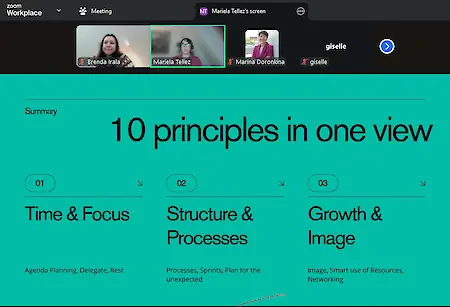
🕰️ 1. Time and Focus
Growth isn’t about doing more — it’s about doing what truly matters.
✅ No agenda, no meeting:
Every meeting should have a clear purpose, a defined agenda, and actionable takeaways. Protect your time and energy.
✅ Delegate more:
Let go of micromanagement and trust systems instead of relying solely on people. Build repeatable processes and document knowledge so others can take initiative. Tools like the RACI Matrix (Responsible, Accountable, Consulted, Informed) help clarify roles and empower smarter decision-making.
✅ Rest is strategy:
Taking time off fuels creativity and clarity. Try time-blocking, no-meeting days, or scheduling “focus weeks.”
Remember: 20% of your time should go to strategy, 80% to operations — but that 20% determines your success.
🧭 2. Structure and Processes
Structure gives you freedom — not restriction. It provides the foundation for growth, scalability, and peace of mind.
✅ Plan for the unexpected:
Storms will come. You can’t avoid them, but you can prepare. Build flexibility into your plans, diversify your income streams, and avoid over-dependence on one client, supplier, or team member.
Ask yourself: What would happen if this source disappeared tomorrow?
Document knowledge, share information, and build resilience through preparation.
✅ Create processes:
Scalability comes from repeatability.
Use checklists, templates, reports, and automation tools (like Confluence, Notion, or even simple Word docs) to streamline your work. Processes create efficiency and consistency.
✅ Sprint and reflect:
Work in short cycles — one or two weeks — and review what’s working.
Use the Start–Continue–Stop model:
-
Start doing something that moves you forward
-
Continue what’s already working
-
Stop what’s slowing you down or no longer adds value
It’s not about doing more — it’s about doing smart. Focus on momentum, not perfection.
🌿 3. Growth and Image
Growth and image go hand in hand — how you present yourself shapes how others perceive and trust your business.
✅ Professional image matters:
Consistency builds credibility. Use your logo, colors, and slogan across business cards, social media, and websites.
Your image speaks before you do — it sells trust and reliability.
✅ Invest resources strategically:
Growth isn’t only about money. Leverage partnerships, scholarships, grants, and collaborations.
Map your stakeholders and identify which relationships help you grow — financially, strategically, or through learning.
✅ Networking with purpose:
Networking isn’t about collecting business cards — it’s about building meaningful connections.
Ask: How can I bring value to this person?
Set small, intentional networking goals (e.g., one new LinkedIn post per month or one deeper conversation per event).
Use a Stakeholder Mapping Tool to identify who to engage closely, keep informed, or simply monitor.
Growth is not an event — it’s a journey.
✨ Final Reflections
A growing mindset means staying curious, flexible, and intentional — no matter the size or stage of your business.
Key takeaways to remember:
-
Protect your focus — time is your most valuable resource.
-
Build systems, not chaos — structure creates freedom.
-
Invest smartly — in people, tools, and your own learning.
-
Connect with purpose — meaningful relationships build long-term growth.
So you can run your business in a smarter way, not harder. 🚀