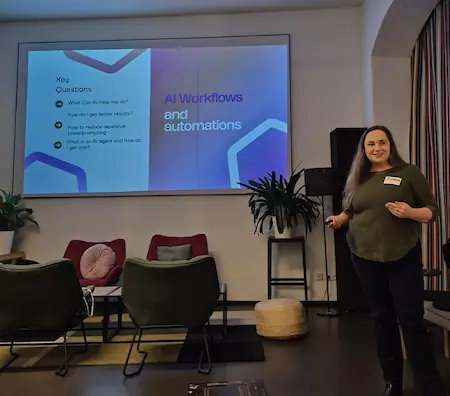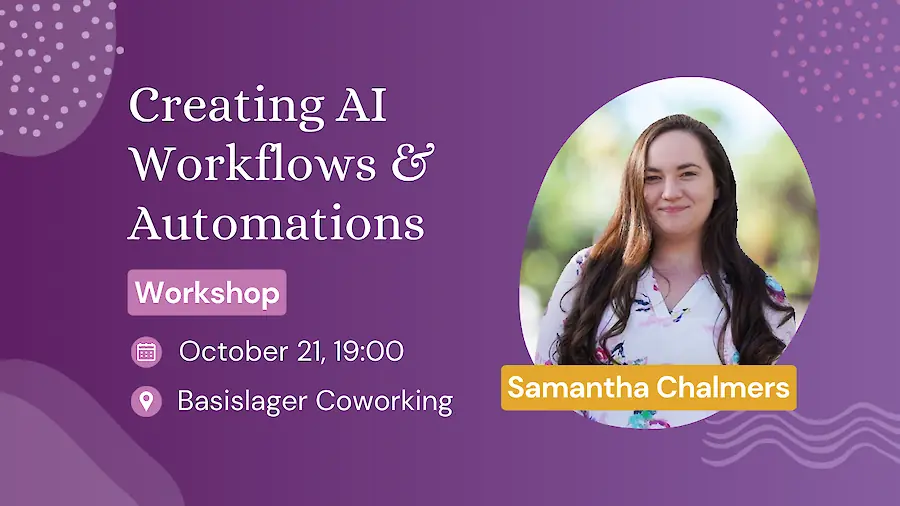
Speaker: Samantha Chalmers
Connect with Samantha on LinkedIn
Intro
AI tools can support entrepreneurs, freelancers and creative professionals in many everyday tasks, from planning projects and researching information to organizing workflows and developing ideas.
AI is a tool to support your thinking, not replace it. Think of it as a calculator, not a brain. The better you define your problem and provide relevant information, the more useful the results are likely to be.
1. Choosing the right AI tool
Different AI platforms have different strengths. The best choice depends on your task, your existing tools and the kind of output you need.
-
Microsoft Copilot: Useful for working within the Microsoft ecosystem, supporting productivity tasks and learning new skills.
-
Google Gemini: Useful for research and tasks connected to Google's ecosystem. Its outputs can support fact-checking, but important claims should still be verified against reliable sources.
-
ChatGPT: Useful for planning, outlining, brainstorming, structuring information and organizing projects.
-
Claude: Often useful for working with long documents, nuanced writing, complex instructions and project-related tasks.
These are general starting points rather than strict rules. All four tools can perform many overlapping tasks, and their capabilities evolve over time.
Tip: Choose the tool based on the task, not just on the brand. Test different tools with the same prompt to compare the results.
2. Data privacy and safe AI use
Before sharing information with an AI platform, consider whether the information is appropriate to disclose.
Information generally suitable for AI tasks:
-
Publicly available information.
-
Non-sensitive work context.
-
Anonymized examples and fictional scenarios.
-
General descriptions of business challenges, projects or workflows.
Information to protect:
-
Personal contact information and identifying details.
-
Financial information, banking details and payment data.
-
Passwords, access credentials and confidential business information.
-
Sensitive customer, employee or client data.
-
Private documents or information you are not authorized to share.
When in doubt, anonymize information, remove unnecessary details and check your organization's policies and the platform's data settings.
Understanding AI memory and deletion
Some AI tools can use information from previous conversations or saved memories to personalize responses. Features and settings differ between platforms.
Deleting a chat, deleting a saved memory and requesting the deletion of account data are not necessarily the same thing. Retention periods and exceptions also vary by platform.
For ChatGPT, deleted chats are generally scheduled for permanent deletion within 30 days, subject to applicable legal, security and other stated exceptions. Saved memories and other data may follow separate processes.
Tip: Review the privacy and data controls of the AI tools you use. Never assume that information disappears immediately just because you delete a conversation.
3. Tokens and tokenizers: How AI processes information
AI models process text in units called tokens. A token can represent a whole word, part of a word, punctuation or another piece of text. The exact breakdown depends on the model and its tokenizer.
For example, a short sentence might be divided into several tokens rather than one token per word.
Why do tokens matter?
-
Prompts, responses and other content processed by the model use tokens.
-
Models have limits on how much information they can process at once.
-
Token usage can affect costs or usage limits, depending on the platform and model.
-
Very long prompts and conversations can consume more of the available context.
How can you use tokens efficiently?
-
Be concise without sacrificing important context.
-
Remove irrelevant or repetitive information.
-
Use clear instructions and relevant examples.
-
Structure longer information with headings or bullet points.
Typos and punctuation can affect tokenization, but they do not automatically make a prompt inefficient. The goal is not to minimize tokens at all costs. The goal is to communicate clearly while avoiding unnecessary information.
4. Context windows and conversation management
A context window is the amount of information a model can process within a particular interaction. Depending on the system, this can include your prompts, previous messages, uploaded content and other information provided to the model.
As conversations grow, they can become more difficult to manage. Older details may become less accessible, and a conversation may eventually reach its context limit.
This is why the workshop's principle was: Chats are meant to die.
Instead of continuing one conversation indefinitely, start a fresh chat when the topic changes or the conversation becomes too long. Carry over only the information needed to continue the work.
How to transfer context
-
Compact: Identify the most important information.
-
Summarize: Capture the relevant context, goals, decisions and open questions.
-
Handover files: Attach the relevant documents or other resources to the new chat.
Example prompt:
"Summarize the key details of this conversation, including the project context, goals, decisions made, important constraints and open questions. Create a concise handover summary that I can paste into a new chat to continue the work."
This helps you preserve continuity without carrying unnecessary information into every new conversation.
5. Prompting best practices
The quality of an AI response depends heavily on how clearly you communicate what you need. A vague prompt often leads to a generic answer, while a well-structured prompt gives the AI a clearer direction.
Give the AI a role
Tell the AI what perspective or function you want it to adopt.
Examples:
-
Thinker: Help me challenge my assumptions and explore alternatives.
-
Creator: Help me generate creative ideas and new approaches.
-
Research assistant: Help me investigate a topic and identify reliable sources.
-
Copilot: Help me work through a task step by step.
A role helps establish the perspective, but it does not guarantee expertise or accuracy.
Use the C-G-A-R framework
A structured prompt can include four elements:
C — Context: What is the situation?
Explain the background and relevant circumstances.
G — Goal: What do you want?
Describe the outcome you want to achieve.
A — Actors: Who is involved?
Identify the relevant people, audiences, stakeholders or roles.
R — Request: What specifically should the AI produce?
State the task and the expected format, level of detail or length.
6. AI agents and workflows
An AI agent is designed to do more than answer an individual prompt. Depending on its capabilities and configuration, it can pursue a goal through multiple steps, use connected tools and carry out tasks with less continuous human input.
How agents differ from regular chats
Regular AI chat: You ask a question, receive a response and decide what to do next.
AI agent: You define a goal and relevant boundaries. The agent can plan steps, use available tools, execute actions and adapt its approach as it works toward the goal.
Potential applications for entrepreneurs and freelancers include:
-
Researching a market and organizing findings.
-
Supporting repetitive administrative workflows.
-
Processing information from connected documents or tools.
-
Coordinating multiple steps in a project.
The more autonomy an agent has, the more important it is to define clear objectives, permissions and limits. Review its work, particularly before it sends messages, publishes content or makes consequential changes.
Final takeaway
AI can be a valuable partner in entrepreneurship and freelance work when you know how to direct it.
Remember these five principles:
-
Choose the right tool for the task.
-
Share information responsibly and protect sensitive data.
-
Understand tokens and context windows to manage your interactions effectively.
-
Write structured prompts with clear context, goals, actors and requests.
-
Use critical thinking and treat AI as a tool that supports, rather than replaces, your own judgment.
The most important skill is not simply knowing how to use AI. It is knowing what you want to achieve, how to communicate that goal and how to evaluate the results.